Summer of Ice Cream
2026 was the summer of ice cream. It began when we were in Europe: Vilnius seemed to have little ice cream stands here and there in the Old City, and really nice stuff, too – home-made flavours with cool additions and whatnot. Also, there was a place right near our hotel that had pink waffle cones! I mean, why aren’t all waffle cones pink??? Someone suggested that it was because that would mean putting nasty food colourant in the cone batter. But Lithuania is nothing if not the land of beets… I’m willing to bet those cones were naturally coloured. Later, in Germany, when it was 40 degrees, we ate ice cream at every opportunity. The Germans don’t do things like A/C and iced drinks they way we do in North America, so cold beer and ice cream were essential. We did end up at a fancy Italian ice cream bar in Mainz, and they served us tall swishy glassware filled with frothy party-coloured ices and whipped cream and pizelle and whatnot.

Back home, I leaned into my good old ice cream maker. Please understand, it wasn’t even that hot in Vancouver this year, but this is still important. We were given our old Donvier manual-crank machine as a wedding gift decades ago and it still works great: you leave the aluminum inner cylinder in the freezer overnight, and then you pour your cooked and pre-chilled custard (or whatever) into it and crank the handle for 15–20 minutes. Works like a charm.
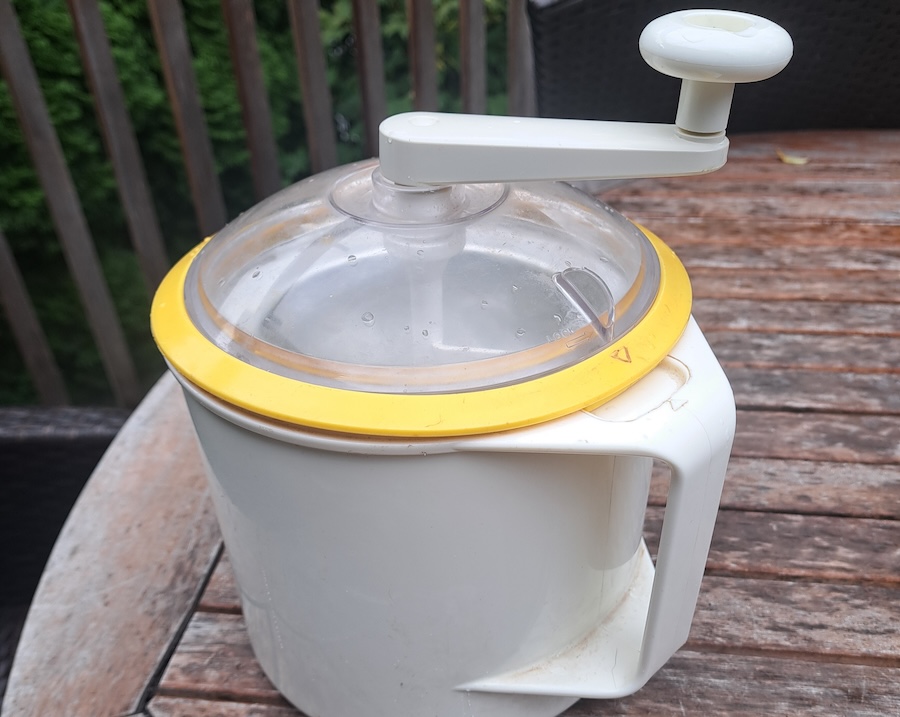
I did enough of it this summer that I felt like I was getting good at it; which is why this post. I want to deliver some insights into what works and what doesn’t.
Methods
I have settled on a basic recipe from the excellent Great Scoops cookbook from Ottawa’s The Merry Dairy. My friend Heidi at the publisher (Figure 1) passed this to me a few years back, and it’s the best resource I’ve seen. The basic Merry Dairy method is like so:
-
Heat 2 cups cream, 1 cup milk, 1/2 cup sugar, tiny bit of salt until it begins to steam; take it off the heat.
-
Gradually whisk the heated cream mixture into five egg yolks until you have a lot of warm egg/cream; then pour that back into the pot and apply heat again
-
Cook, stirring constantly, until it reaches 180ºC, at which point it is custard. Strain that into an ice bath (a pair of pyrex bowls with ice cubes in between) and chill it down. Straining it catches any gunky bits of eggwhite that you didn’t successfully separate out. At this point you add vanilla or whatever.
-
Chill the custard in the fridge for a while (like, overnight) so that when you put it in the machine, the machine doesn’t have to overcome excess heat. This matters a lot, in my experience. Let it chill!
-
Then pour it into the machine and churn for 15–20 minutes. My method is to churn very slowly at first, until the custard starts to come together as a semi-frozen mass, and then speed up churning toward the end to mix more air into it, which will give you a softer end-result.
-
Transfer the new (very soft) ice cream into a pre-chilled container, as fast as possible, and get those back into the freezer for a couple of hours to firm up.
That’s not a quick method, but the results are stellar. It’s rich, creamy, smooth, and not hard as a rock when it comes out the freezer.
Flavours
In the summer, I made a bunch of batches of vanilla, because it’s so easy to just top it with strawberries, blueberries, blackberries, or what-have-you. I also rendered some of those things down into compote, to pour over and/or mix into the ice cream. Pretty easy, and so amazingly good.
But I have a couple of standbys: one is mint. I have a pot of spearmint in the backyard that produces loads of fragrant leaves. A big handful of leaves, steeped in warmed milk for an hour or so (basically: extend Step one above before you temper the eggs) makes brilliant mint flavour. You could then add mini chocolate chips as you churn the finished custard. Or you can use the mint cream as the basis for something else (I did this with blueberry, and that was pretty good.)
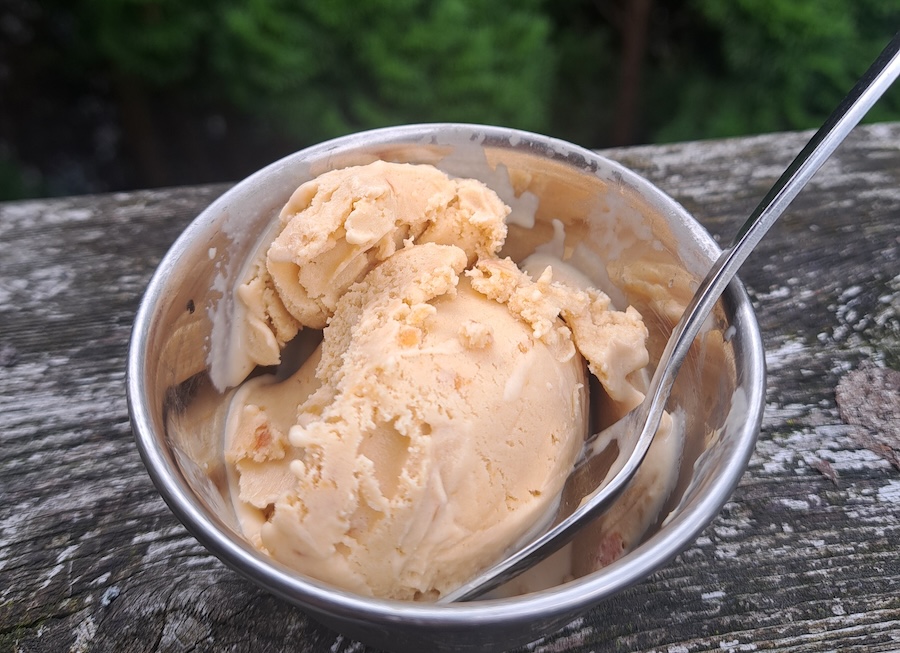
My other summer favourite is peach brown sugar; first blend/blitz two or three ripe peaches, then macerate them with 1/2 cup demerara sugar and half a lemon’s worth of juice. Let that sit for half-an-hour or more, then strain it (vigorously) so that you separate the liquid from the solid peach bits. The liquid goes into the cream mixture (and use brown sugar instead of the usual white); the solid peachy bits go in as a swirl, at the very end, as the ice cream comes out of the churner and into freezer containers. This is such a great flavour!
What not to do
Twice this summer I had my custard curdle – or at least, take on a slightly ‘cheesy’ aroma. This is, I’m pretty sure, about the freshness of the ingredients: always use brand new, fresh milk and cream; otherwise any acids (from fruit, from demerara sugar, from fresh mint leaves even) will turn the milk as soon as you add heat.
The Great Scoops cookbook recommends adding cooked fruit directly too the cream: the blueberry I made worked that way; but I’m skeptical; I think it might be safer to mix this in at the end, just before it goes into the ice cream maker – cold – rather than sitting in a hot pan with the cream and milk.
One other pitfall, and I experienced this with both a roasted rhubarb recipe and my cooked blueberry one, is a slightly sticky, cloying mouth feel that I suspect might be pectin: if we cook the fruit, this happens; if we don’t, it doesn’t seem to. So I’m for keeping the custard simple and adding fruit toward the end of the process.
None of these pitfalls are really all that awful; I happily ate my lurid purple blueberry mint despite the vague cheesiness, which to be honest mostly disappeared after a couple days in the freezer. The most important point is this: Do you have an ice-cream maker? If not, why not? Go get one! Summer is better with fresh ice-cream that you made at home.