European tour 2026
We (daughter and me) went to Europe in June. Invited to be part of an Erasmus+ exchange by our fabulous Publishing Studies colleagues in Lithuania (and who came to Vancouver this past winter), we made the trek way, way east – the other side of Poland! – to Vilnius, the Lithuanian capital.
(Typographic geek note): I loved that our flight from Frankfurt to Vilnius was aboard a Lufthansa A321 painted in retro 1950s style. Pre-Helvetica, that is. No I didn’t get a photo, and I regret that.
Vilnius is an ancient city in an ancient land with a complex and fascinating history; a late-medieval powerhouse in northeastern Europe, and the last major polity in Europe to be “Christianized” (in the 14th century, although dating it with precision is a fool’s game, as it was a fraught process for many centuries). The city as we know it today was established by the brand-new Jesuit Order in the mid-16th century, where they came to establish Catholicism and a University. Both are still there, perfectly preserved (or at least restored) in one of the best “old towns” in Europe. To be honest, there are more churches than you can shake a snake at in Vilnius: most Catholic, some Orthodox, some protestant, but representing every conceivable architectural period. The old University complex still forms the heart of the old city, though. It was utterly charming: little narrow winding lanes, cool shady courtyards, cafés and little shops everywhere.
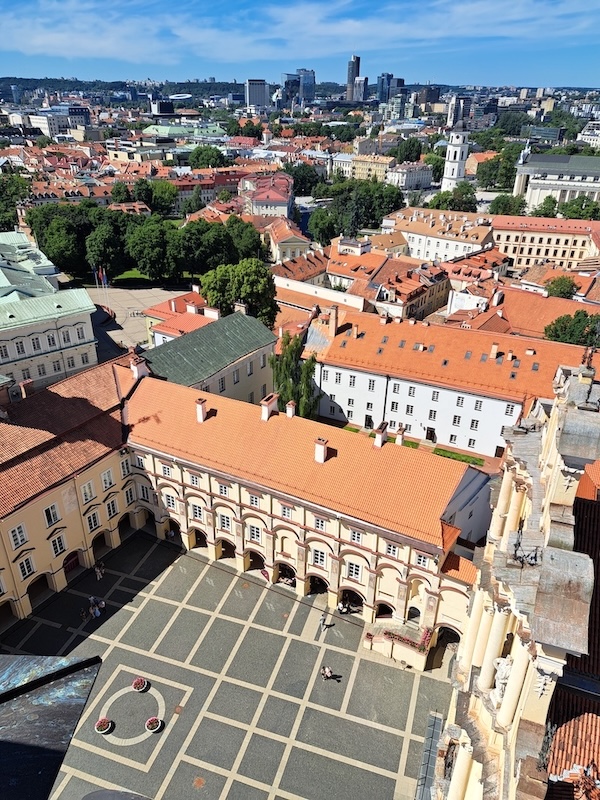
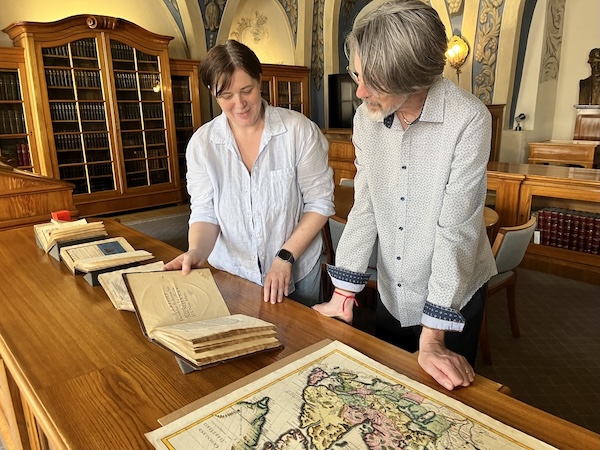
And they have a Publishing Studies program! And a 470-year old Library with 470-year old books in it that I got to visit!
We happened to be there for graduation ceremonies, so the university courtyards were full of grads with their fancy shoes on, and moms bearing bouquets, and general cheer. Also the weather was perfect while we were there, which helped.
The weather was less than perfect at our next destination. After 4 days in Vilnius we flew back (plain old Helvetica this time) to Germany to attend the Publishing Studies conference, By the Book, in Mainz (home of Johannes Gutenberg, you know). Western Europe was at that point in the midst of the worst June heatwave in history, and it was pretty close to 40º every day we were there. Not so bad if you stayed indoors, but the trams and buses were murder; thankfully there were shady patios, and large glasses of beer. All in all, By the Book was lovely – a charming friendly little conference full of charming friendly people who teach publishing! But I wanted to dwell on one particular experience, which made me think.
The opening keynote was by a VP at Springer-Nature in charge of the company’s DEI efforts. She started out all gee-whiz, about the astounding numbers: so many zillion journals, however many bazillion journal articles; tens of quintillians of books published, and growth! Wow 30% more of something compared to last year: so much so that they need to develop AI tools to just deal with it all! Now, Springer-Nature was, I think, a sponsor of the conference; in exchange they get to deliver their good-corporate-citizen spiel; and in return, this poor woman has to field questions from a pretty well-informed and maybe cranky audience. The audience questions were pretty pointed: “How exactly do you define ‘growth’?” and “Business in China, eh? What about the Uyghurs?” to the point where a colleague of hers suddenly appeared on the sidelines to help field some of the questions. Anyway, big deal: they’re adults, they can deal with a snarky audience.
But I found myself thinking about my own presentation – about ‘prototyping’ in publishing, and the effects of scale on a firm’s ability to play the prototyping game. Why is small-scale prototyping, as I was championing, any different than planet-scale data-driven innovation, as S-N and their peers engage in? On the face of it, this is the same thing: we design, deploy, test, and iterate – at all scales. Does their tale of gigantic-scale data- and AI-driven innovation undermine my ideal of a small-enough-to-tinker aesthetic?
The difference, I thought, has to be at the level of care. If we are making giant-scale data-driven decisions and innovations, we are, cannot be driven by care for human engagement itself, only at a metricized proxy for that engagement – like a VP of ‘diversity’ at a giant corporation might be concerned with.
One of the drivers of my thinking about prototyping[1] was about scholars not taking their scholcomm infrastructure for granted (as we in fact have done for the past couple hundred years). We wanted to emphasize scaling small as a means of increasing agency at the small, scholar-led level, as opposed to merely pouring our content into a large infrastructure provider. What’s different in the big corporate model is that the agency is consolidated at the higher levels, which disenfranchises human-scale work, which devalues the scholarly work itself: indeed commodifies it. So it occured to me now, it’s not that the prototyping practice is different; it’s about who has access to it.
So “scholar-led” is actually key here. At dispute is the modern constitution, which isolates ‘research’ as the purview of indivdual scholars (that is, grantwinners and authors), while steadily circumscribing everything outside that narrow definition – all the infrastructural elements, from research management to publishing to assessment, which become the property of big infrastructure corporations like Elsevier and Springer Nature.
Back to the Uyghurs… or the Palestinians… there was an excellent audience question about about how a corporation can respond to sensitive stuff in sensitive contexts. The Springer rep just swung at the end of that question: because they cannot, corporately, do anything but remain ‘neutral.’ Because at that scale (at the scale of what? of financialization?) taking an ethical or political stand on something is impossible. A financialized corporation (which lives by its share price more than what it produces) cannot afford to have values because that would go against scale; instead they can at best only afford to have people within who might have opinions of their own, and to try to not curtail those individuals in being participants in the organization, in its relentless pursuit of ‘growth.’
That might be the point where the rubber hits the road. Are we (in institutions of whatever kind) a human community, or are we something beyond that, something post-human? A community can have values (however contested and imperfect that might be realized), but a corporation can actually not.
Alessandra and I had written up our argument about prototyping and scale in a recent issue of Journal of Electronic Publishing: https://journals.publishing.umich.edu/jep/article/id/7837/ ↩︎